
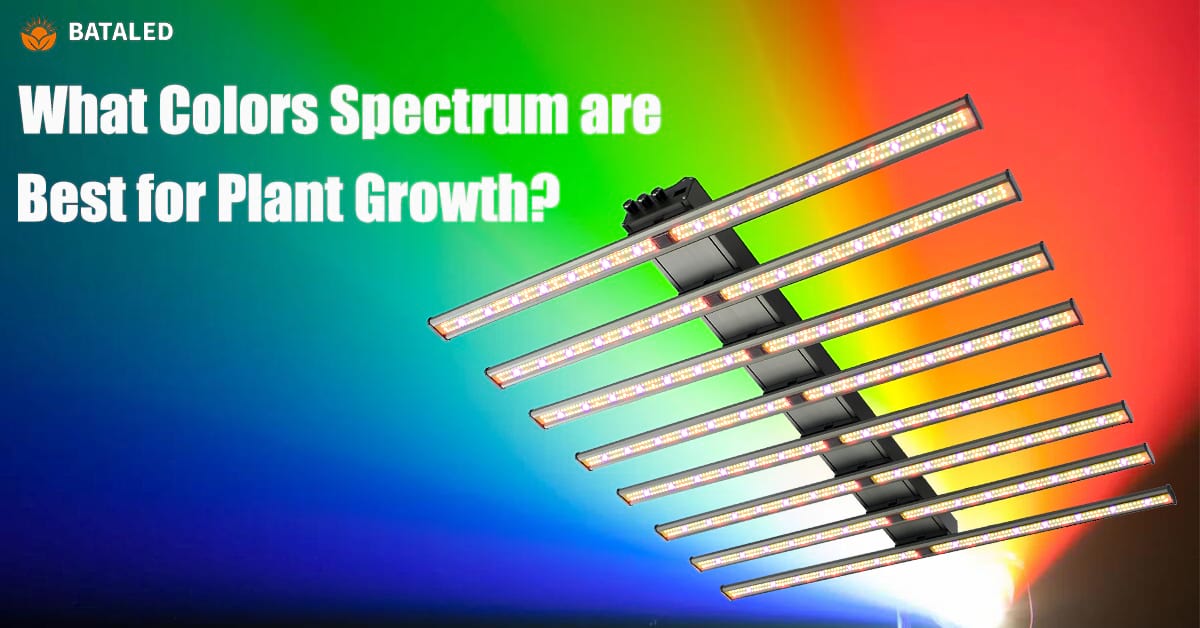
The Grow Light Spectrum Guide: Unlock Healthier Plants and Bigger Yields
Have you ever wondered why indoor plants, even with the same care, never seem as vibrant and productive as those basking in natural sunlight outdoors? The secret likely lies in the “light” you provide. For plants, light is more than just an energy source to brighten their surroundings; it’s like a precisely coded instruction language, directly dictating how they grow, when they flower, and how many flavor compounds they accumulate. Understanding and mastering this plant grow light spectrum is the key to elevating your indoor gardening or commercial cultivation from “barely surviving” to “thriving, lush, and highly productive.”
This guide will take you deep into the world of light spectra, reveal the science behind different colored light, and provide you with a complete strategy from theory to practice, helping you truly unlock your plants’ full potential.
Understanding the Light Spectrum: What is Grow Light Spectrum?
The white light we see is actually a mixture of countless different colors. Just as sunlight disperses into a rainbow through a prism, each color corresponds to a specific wavelength, measured in nanometers (nm). The grow light spectrum refers to the specific range of wavelengths emitted by an artificial light source that plants can absorb and use to promote their growth and development.
For plants, the most important spectral range is called “Photosynthetically Active Radiation” or PAR, roughly covering the 400 nm to 700 nm band, which includes blue, green, yellow, orange, and red visible light. But plants’ “vision” is broader than ours; they can also perceive ultraviolet (UV) and infrared light, which are invisible to us. These non-visible bands subtly influence plant health, morphology, and even flavor. Therefore, an excellent spectral plan is never limited to just red and blue but should provide comprehensive and balanced “light nutrition,” much like natural sunlight.
Types of Growth Light Spectrum: Effects of Different Spectra on Plant Growth
If a plant is compared to a discerning diner, then different wavelengths of light are the various dishes on its menu, each playing a unique and irreplaceable role in the growth process. Understanding the specific effects of each color spectrum is your first step in formulating the perfect light recipe for your plants.
Ultraviolet Light (UV Light) Spectrum
Ultraviolet light lies beyond visible violet light and is high in energy. It’s mainly divided into UVA, UVB, and UVC based on wavelength. In nature, UVC is blocked by the ozone layer, while UVA and UVB reach the ground.
An appropriate amount of UVA (315-400 nm) can, like blue light, encourage plants to grow more compact and sturdy. It also thickens plant cell walls, acting like a “soft armor” that boosts resistance to pests and diseases.
The more potent UVB (280-315 nm) acts as a mild “stress signal,” stimulating plants to produce more secondary metabolites like flavonoids, anthocyanins, and terpenes.
For gardening enthusiasts, this means the herbs you grow will have more intense flavors, and strawberries will be sweeter. For commercial growers, especially in cannabis cultivation, this can potentially lead to higher concentrations of target active compounds. Of course, just as excessive UV in sunlight can sunburn skin, overly strong UV light can damage plants, so dosage and duration must be carefully controlled.
Blue Light Spectrum
Blue light, with wavelengths between 400 and 500 nanometers, is absolutely central for plant seedlings and the vegetative growth stage. It efficiently drives photosynthesis, but its more crucial role is “sculpting.” Blue light effectively inhibits excessive stem elongation, promoting lateral growth, resulting in shorter, denser internodes, and thus forming an ideal, compact, and stocky plant structure.
This is vital for maximizing light coverage in limited spaces (like grow racks or tents). Furthermore, blue light directs plant “phototropism,” guiding them to grow towards the light source, and regulates the opening and closing of leaf stomata, affecting water transpiration and CO2 uptake. It’s fair to say blue light is the “foundational engineer” building a solid framework for plant growth.
Green Light Spectrum
For a long time, green light (500-600 nm) was considered useless for growth because most of it is reflected by plant leaves (which is why plants appear green). However, the latest research has completely overturned this notion. Precisely because it isn’t strongly absorbed by upper leaves, green light has exceptional penetrating power. It can reach the bottom of a dense canopy, “waking up” the lower leaves shrouded in shadow to participate in photosynthesis.
This is akin to activating “idle workshops” in the entire factory, significantly boosting the plant’s overall biomass output. Additionally, green light mixed with red and blue produces a white light that is comfortable for our eyes, making it easier to observe plant health. Therefore, in modern full-spectrum LED grow light design, green light has transitioned from a “supporting role” to a “key player” that enhances overall efficiency and observational convenience.
Yellow Light and Orange Light Spectrum
The direct impact of yellow light (570-590 nm) and orange light (590-620 nm) on plant growth is relatively mild when acting alone, but they are far from redundant. They often play the role of “coordinators.” For example, research has found that yellow light combined with blue light can promote root development in some plant seedlings, while orange light paired with red light can enhance photosynthetic pigment synthesis in crops like lettuce.
Their presence makes the spectrum more complete and balanced. Like spices in cooking that aren’t the main ingredients, they subtly harmonize the overall flavor and effect, helping plants respond more balancedly to different environmental conditions.
Red Light and Far Red Light Spectrum
Red light, with wavelengths between 620 and 700 nanometers, is the “high-efficiency fuel” for photosynthesis. Chlorophyll in plant leaves has the highest absorption rate for red light, especially in the deep red region around 660 nm. This means red light is most directly converted into energy for plant growth. It strongly promotes stem and leaf expansion, leaf enlargement, and flowering/fruiting, serving as the core driver for increasing yield. However, an excessively high proportion of red light can easily cause plants to become “leggy”—with weak stems and overly long internodes.
Far-red light (700-750 nm), adjacent to red light, is an interesting “environmental signal lamp.” When plants perceive an increased proportion of far-red light (typically in shaded environments where upper leaves filter out red light but reflect far-red), they interpret it as being in a competitive state, triggering a “shade avoidance response” to accelerate stem elongation in a race for sunlight. Skillfully leveraging this—by appropriately increasing far-red light during the flowering stage—can serve as a signal to promote flowering in some short-day plants (like cannabis).
Infrared Light (IR Light) Spectrum
Infrared light, with wavelengths exceeding 780 nm, is perceived by us as heat. Appropriate infrared radiation can gently raise plant tissue temperature, promoting metabolic activity and helping maintain growth vitality in cool environments. Some professional LED grow lights include specific infrared bands to simulate the thermal effects of natural sunlight, aiding in the regulation of plant physiological processes. But control is key, as excessive heat buildup is a core issue all indoor cultivation seeks to avoid.
Your Personalized Spectrum Strategy: Finding the Right Growth Light Spectrum
After grasping the role of each light color, the next step is to “formulate” a recipe for your specific growing project. There’s no single answer, but by following the logical framework below, you can certainly make the optimal choice.
Understanding Grow Light Spectrum Charts and Ratios
When choosing a grow light, you’ll inevitably see spectrum charts that look like electrocardiograms. The horizontal axis is wavelength (nm), and the vertical axis is relative intensity. Focus on two core aspects: peaks and ratios. High peaks typically appear at 450 nm (blue) and 660 nm (red), indicating strong output in these two critical bands.
Based on spectral shape, lights on the market generally fall into three categories:
-
Full Spectrum Lights: Simulate sunlight but significantly enhance red and blue peaks. Suitable for the entire plant growth cycle.
-
Broad Spectrum Lights: Feature a more even energy distribution, focusing on overall plant health.
-
Targeted Spectrum Lights: Designed for specific stages (e.g., flowering only) with highly concentrated spectra. Understanding these charts and types is the first step towards rational choice, moving beyond marketing claims.
Growing Environment is Key
Your growing environment is the primary factor determining your spectrum strategy, often overlooked by beginners. In a greenhouse or a structure with natural light, your LED lights play a “supplemental” role. You need to adjust the spectrum and intensity of supplemental lighting based on seasonal and weather changes to compensate for natural light deficiencies—for example, increasing light during winter overcast days or extending daily light duration.
In a fully artificial indoor environment, like a vertical farm or grow tent, your LED lights are the “sole” light source. Here, you need a comprehensive full-spectrum LED solution that can completely simulate or even optimize the diurnal and seasonal variations of sunlight, responsible for the plant’s light from start to finish. Different starting points require vastly different strategies.
Different Plants Have Different “Recipes”
Just as people have individual differences, different plants have different light preferences. Growing leafy greens like lettuce and spinach requires a higher proportion of blue light to promote lush leaf growth and inhibit bolting (premature flowering).
Cultivating fruiting crops like tomatoes and strawberries requires a significant increase in the proportion of red and far-red light during the flowering and fruit-setting stages to stimulate flower bud differentiation and fruit expansion.
For special economic crops like cannabis, growers focus not only on yield but also on the content of specific cannabinoids, leading to extremely detailed requirements for the UVB band and precise red-to-blue light ratios.
Therefore, understanding your crop’s spectral “taste” beforehand is key to success.
Spectrum Needs Change with Each Growth Stage
A plant’s light requirements change dynamically throughout its life. A simple three-phase approach is:
-
Seedling/Propagation Stage: Provide cool white light (high color temperature) rich in blue light. This cultivates sturdy seedlings with thick stems that are less prone to lodging.
-
Vegetative Growth Stage: Switch to full-spectrum white light with a balanced blue-red ratio. This promotes comprehensive development of leaves and roots, building a lush canopy.
-
Flowering/Fruiting Stage: Transition to warm white light (low color temperature) rich in red and far-red light. Consider supplementing with a small amount of UV during specific periods. Use this as a signal and energy source to fully drive flower opening, fruit ripening, and flavor compound accumulation. This staged lighting strategy maximizes efficiency for each growth phase.
Holistic Perspective – Systematic Planting Solutions
However, focusing solely on the spectrum is far from enough. The most successful growers understand that light is a key variable, not the entirety, of the growth equation.
The 8-Factor Symphony: Why Light Alone Isn’t Enough
Plant growth relies on a synergistic system comprising eight factors: light, carbon dioxide (CO2) concentration, temperature, humidity, air circulation, water, nutrients, and root-zone temperature. Overly strong light without sufficient CO2 and water support can cause photosynthesis to “stall.” High temperature and humidity without enhanced airflow invite disease. Excellent growers always view this with a systems mindset, allowing light to harmonize with the other seven environmental factors to orchestrate a high-yield, high-quality, and efficient growth symphony.
The Future is Programmable: From Static Light to Dynamic “Climate Recipes”
The true potential of LED technology lies in its unparalleled controllability. The future frontier is no longer about providing a fixed grow light spectrum but upgrading it into a dynamic, programmable environmental control tool.
This means you can program lights to simulate the color temperature and intensity changes from sunrise to sunset within a day, or even simulate seasonal shifts—for example, by providing a long-term spring-like spectrum to delay lettuce bolting and extend its optimal harvest window.
This ability to create precise “digital climate recipes” represents the pinnacle of Controlled Environment Agriculture (CEA). It allows growers not only to meet plants’ basic needs but also to actively guide their growth trajectory to achieve optimal commercial or horticultural goals.
Final Thoughts
The path to healthier plants and bigger harvests begins with a deep understanding of the “language” of light. From recognizing that the spectrum is the core instruction set determining plant form, health, and yield, to learning how to interpret spectrum charts and customize your lighting strategy based on environment, crop, and growth stage, you’ve now grasped key knowledge that surpasses most hobbyists.
Remember, whether choosing a simple full-spectrum LED grow light for a home tent or designing a complex tunable multi-spectrum LED system for a commercial greenhouse, the principles are the same: provide a balanced, comprehensive, and suitable spectrum, and ensure it works in harmony with all other elements in your growing environment. May this guide help you unlock the infinite potential of plant life and reap a garden full of vitality and bountiful harvests.
CATEGORIES
Recommended Post

Where It’s Legal to Grow Cannabis: Ultimate Tips & Cultivation Laws
About Author—Jose Li
Jose, a senior content creator at BATA LED, brings over 5 years of expertise in LED grow light. He delivers valuable insights to help growers and farmers better understand LED grow light technology, empowering them to boost crop yields and quality with advanced lighting solutions.